Category Archives: Uncategorized

Jahrat Adib Chowdhury

photo-jachowdhuryFEM-PROFILE:

Jahrat Adib Chowdhury is Chief Legal Officer at Banglalink, a Vimpelcom Group company. She is a Barrister-at-Law of Lincoln’s Inn, UK and an Advocate of the Supreme Court of Bangladesh. Jahrat speaks with us today about her formative experiences, what it means to be a senior leader in one of the country’s leading telecommunications and digital companies, and how she fulfills her personal and professional duties.

What made you decide to become a barrister and corporate lawyer?

I grew up in a small town called Moulvibazar where my father used to run his law chamber in the front room of our house. He had several junior lawyers in his chamber, including two of my male cousins. My father inspired all of his four daughters to follow his legal career and eventually take over the chamber. However, we grew up listening to jokes from my cousins that we would never be practicing law as we were girls, so they expected to inherit the chamber along with my father’s huge collection of law books. Without really understanding of the depth of their jokes, I became angry.

Continue reading

SEXUAL HARASSMENT IN THE WORKPLACE

By Anja Uitdehaag

 “I am not your dog that you whistle for; I’m not a stray animal you call over, and I am not, I never have been, nor will I ever be, your “baby”!” – Joy Jennings

According to the Trades Union Congress report, Still just a bit of banter? Sexual harassment in the workplace in 2016, more than half (52%) of women and nearly two-thirds (63%) of young women have experienced sexual harassment in the workplace. Out of these, four out of five (79%) said that they did not report it to their employer.

Continue reading

I Am Just Doing My Job!

by Anja Uitdehaag

If you are anything like me, you probably believe your work should speak for itself.

Women, more often than men, believe that hard work will be recognized and pay off and do not do enough to network with their organization and self-publicize their achievements. When a more senior position opens up, they assume they will be considered based on their accomplishments and credentials, despite having been reluctant to voice them.

Continue reading

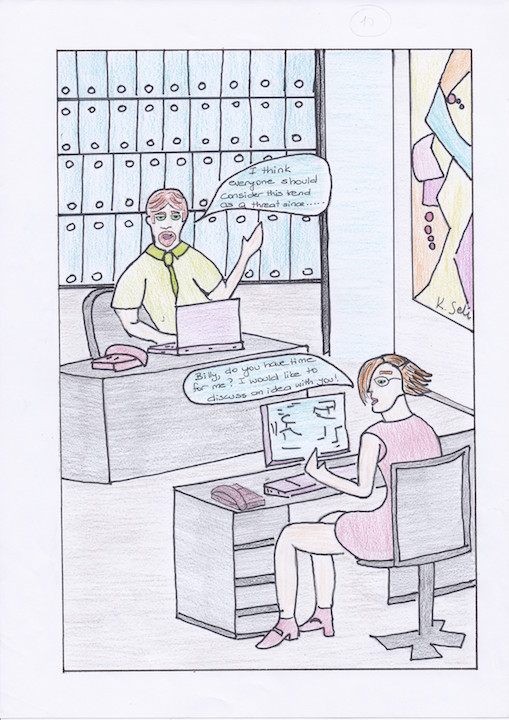
SITUATION 31: SHIFTING ROLES

During the weekly team meeting, work progress of a special project is being discussed. Billy is unable to complete his part of the project due to vacation. Femsy – not happy – replies “Well let me handle it”. Boss is making clear that Femsyis not managing her team; she is “mothering” the team.

(Click on the pictures to see them in full size)

A great leader:

  • Sets clear expectations of what she wants from her team members both in their behaviours and required outcomes;
  • Understands the unique capabilities of her team and works with them to set goals and targets that make the best use of their talents;
  • Keeps on top of project deliveries and ensures that key milestones are met. She asks questions to uncover potential (or actual) difficulties and works to remove obstacles.

How to best handle the situation:

Sit down with your team member to understand the specific problem. Break down the tasks into its components and determine what can be achieved within the required timescale. Agree how the outstanding work will be completed and make sure that your team member is still held accountable for full delivery even if he/she cannot perform the work him/herself.

Reflect on how you lead your team. If you have a tendency to take care of your team and put their personal situation ahead of the tasks that they need to perform, you will not get the desired performance and achieve results. Change your style to be more authoritative. Set out clear goals with your rationale for why these are important. Give individuals personal accountability for delivery and give them balanced feedback on how they are doing.

 Learning suggestions:

  • Craft a clear and compelling strategy for what you need to achieve for each project. Share this with your team and solicit their feedback so that you can answer any questions and concerns they might have. Test their level of understanding and commitment;
  • Make notes about each of your team members. What are their strengths and limitations? What activities do they excel at? What are they passionate about? Try to establish goals and tasks that make the most of their unique talents;
  • Create a project plan that outlines the key tasks and milestones, the person responsible for delivery and the deadline for completion. Share this with your project team. Hold regular project meetings where you discuss progress and identify potential problems. Take actions early to ensure that your project stays on track;

Femchallenge:

  • Take a visible role, such as Chair in an important meeting, or project leader of a task, where you have to shape and lead a discussion and draw out conclusions and decisions.

 Femcommunity tips:

We welcome your thoughts, experiences and comments on how you would deal with such a situation.

Find more on our website Femflection.com

Lindsay’s In Business: part 11: It’s alive!

by Lindsay Uittenbogaard

What happens when you realise your path is entrepreneurship rather than employment? Lindsay takes up the challenge and shares an account of her journey as it unfolds…(you can find previous parts of Lindsay’s story here: Part 1, Part 2, Part 3, Part 4, Part 5, Part 6, Part 7, Part 8, Part 9, Part 10.)

The Mirror Mirror concept had started out in July out as 3 slides before growing into a bigger slide pack, and then into an actual Descriptive Pack, the one we circulated to our Alpha expert test group for comment some time ago (much like a new born being passed around to some doctors for examination). It had survived their tests.

To recap from the last blog: Mirror Mirror is a structured way of capturing how people in teams perceive the internal and external context in which their team operates, including how each team member’s values and preferences tend to shape their perceptions and the way they respond. The combined data is reflected to the team in one whole picture, providing powerful insights that lead to improved engagement, teamwork and business unit performance.

Continue reading

Learning To Learn About Diversity

by Anja Uitdehaag

“Diversity isn’t just sound social policy – diversity is the engine of invention. It generates creativity that enriches the world.” – Justin Trudeau

I very much like the way the University of Maryland defines “diversity”:

“Diversity is “otherness”, or those human qualities that are different from our own and outside the groups to which we belong, yet are present in other individuals and groups.”

Continue reading

Situation 30: DEMEANING YOUR POSITION

Femsy is attending an off-site leadership training. Most participants are more senior than she is. Participants take turns introducing themselves: Femsy introduces herself as: “I am just the sales manager of a small region in an Art Company called “Colors”.

(Click on the pictures to see them in full size)  Continue reading

Situation 9: POLITICAL/RELIGIOUS DISCUSSION

Billy tries to engage Betsy in a heated political discussion. Betsy changes topic.

Situation9 Continue reading

Pat Heim, Tammy Hughes and Susan K. Golant, “Hardball for Women: Winning at the Game of Business: Third Edition”

41k69z4ujnl


Reviewed by Femflection

The authors of “Hardball for women” share their insights into gender differences in the workplace and offer suggestions on how women can soar in male-dominated environments.

It teaches women to use the unwritten rules of business to get ahead in their careers.

The game of business is hardball, played according to the rules of the male culture. The book explains the different behaviors and mind-sets boys and girls learn and carry into their lives as adult men and women. For example, boys learn to compete; girls learn to get along. Continue reading